Engendering Voice: Insights from Common Voice

The origin of Swahili language
Swahili originated from the Indian ocean and has its route from the contacts of Arabian traders with the inhabitants of the east coast of Africa over many centuries. Swahili is the lingua franca of most east african countries spoken largely in countries such as Tanzania,Kenya,Some parts of Congo DRC,Comoros and Uganda among others. In the early 19th century swahili was mostly a trade language and was later adopted by European colonialists, especially the Germans as the language of administration in Tanganyika, thus laying the foundation for its adoption as a national language of independent Tanzania. In other countries within east Africa Swahili is also recognised as one of the national languages although not the formal language of administration.
Over the years several dialects of swahili have emerged to be precise about 15 dialects however the Kiunguja dialect was adopted and made into the standardized swahili which is the modern day swahili spoken in the present day. It has been argued that in the standardization of the Swahili language the voices of the swahili people as a whole was not given a seat hence it was mostly orchestrated by colonial powers and adopted by the communities.
Swahili is Gender neutral
Swahili is one of the languages that is largely gender neutral in specific nouns this is also carried forward in pronouns such as “he/she “ which all translate to one swahili word”Yeye” So there is no masculine or feminine. A researcher sought to understand the dynamics of gender and the swahili people in one of her writing and this is what she had to say”
I seek to counteract widespread tendencies to project assumptions of male dominance onto the past and to uncritically attribute current practices of gender segregation to the presence of Islam. Islam penetrated the Swahili Coast as early as the ninth century, yet gender segregation is a quite recent phenomenon dating back only to the last century. The data presented here cumulatively indicate: 1) that there have been shifts in Swahili society from a time when women occupied positions of greater power, prestige, wealth, and opportunity than is available to them today;⁺ ”
The Swahili Queens
Digging deeper into this we find in history queens along the swahili coast from Mekatili of Mombasa to Mwana wa mema, Queen of Zanzibar and the historical role they played towards fighting colonialisms.A story is told of Mwana Mema of the Zanzibar people in 1650 who joined other Swahili elites in rebellion by forming alliances with the Ya'rubid dynasty of Oman. In 1651, Mwana Mwema invited a Ya'rubid fleet which killed and captured 50-60 Portuguese residents on the island, and she called for further reinforcements by sending two of her ships. However, the reinforcements didn’t arrive, and the elites of Kaole stone-town's rival city on the mainland would ally with the Portuguese to force the Queen out of Zanzibar by 1652.
This stories prove further that gender imbalances within swahili communities were manifested from a white lens and further given wings by colonialism which inevitably played a crucial role to the spread and adoption of the language.This is visible too in the fact that Swahili drew some of its vocabulary from colonial languages such as portuguese,arabic ,English and germany.Over the years the work around Swahili have not given power to the local native speakers of the language and this has led to marginalization and not enough documentation of the language’s fading or disappearing dialects while standardized swahili takes over.
| Mekatilili Wa Menza | Mwana Mwema, Queen of Zanzibar | Sabani binti Ngumi | Mwana Mkisi |
Voice tech and why Swahili
Swahili is now a lingua franca for about 150 million in Africa with the majority of the speakers being from Tanzania,Kenya and Congo DRC.Its one of the most spoken african languages with international recognition such as an official language of the African Union and in 2022 UNESCO horned the language by setting aside a Kiswahili day which is now every 7th of July. The voice tech space currently doesn't support underrepresented languages such as kiswahili hence the need for setting up an infrastructure to ensure the swahili speaking people are incorporated and can access voice enabled services in their language.However in the voice space access to datasets needed is very expensive hence Mozilla’s effort to democratize voice technology by making an open source voice database for kiswahili speakers.
“Ironically, the story of Swahili origins has been molded almost entirely by non-Swahili peoples, a challenge shared with many other marginalized and colonized peoples who are the modern descendants of cultures of the past with extraordinary achievements.”
https://www.sapiens.org/biology/ancient-dna-swahili-origins/
Gender disparities in Voice spaces
Despite the majority of Voice assistants being female by default or depicting female names and voices such as Alexa by Amazon, Siri by Apple among others, there is much to be desired in voice tech for gender inclusivity. The major challenges in having more gender integration in voice space include the lack of gender diverse voice datasets which make speech recognition more responsive to female than male users, access gaps due to gender communal disparities, data protection and privacy. This coupled with the fact that majority of builders are male focused hence biases become a challenge.
The Gender Action Plan
The Kiswahili voice project was aiming to curate a diverse and inclusive community that will help build an inclusive and trustworthy AI. Hence women are a crucial part of the tech and language community the Kiswahili common voice project hopes to curate. According to World Bank Data, the literacy rate for women in sub-Saharan Africa is only 58%, Voice technology can help to break down the digital gender divide by reducing the need for traditional literacy in using applications; this is dependent upon the use, and acceptance, of the technology by women. Engagement and trust-building, with partners sensitive to the need for gender equity, will be vital to this outcome. The project seeks to mitigate AI biases by developing strategies for engagement with women, and on equity in data collection and model creation. Hence the need for a Gender Plan, detailing how gender diversity will be ensured during data collection, model creation and use case development. This Gender Action Plan contains specific gender elements to be considered in the project design and implementation,monitoring and evaluating progress. It will help build an effective strategy for gender mainstreaming in the project ensuring diversity and inclusion.
How to build voice use cases from a gender perspective?
Voice technology has revolutionized how things are done, from the streets workplaces all the way to our homes, people are now using voice as an enabler to access services and navigate menus, roads etc. It's predicted that in the coming years the majority of digital services will be linked to voice, making things more simple. Africa is yet to fully benefit from voice technology as most current applications do not cater for the varying accents and local languages spoken across the continent. For voice technology to be inclusive it needs to cater for the context and languages beyond the western world. In a practical world technology should benefit all genders but the reality is the process building up to building technologies such as voice assistants isn't gender inclusive by design.
Let's make it practical:
“ Company C has built application X for farmers in community Z however majority of the farmers in community Z are women with low-end devices, little to no access to internet yet application X requires its users to have good connection.While some of the women might have smart phones majority speak in their local language Y which is not covered hence this cuts the access by more than half already, adaptation is low and impact not visible.”
While the idea of Company C was great to help rural farmers access markets and implement their design process it did not consider the context and demographics of the community they aimed to serve such as gender.It's imperative to build applications that are user focused and more importantly cater to the needs of those that are usually excluded and this is the case when it comes to gender.In this article I will take you through the journey of how common voice built the kiswahili use cases with gender in mind and draw out lessons and guides to designing voice use cases from a gendered lens.
There are key questions to ask in the process of designing voice use cases as it is in any other AI use case that we asked ourselves when we were thinking about the kiswahili common voice use cases that will be fueled by the common voice kiswahili voice dataset.
1 - What domains do we want to build in?
We researched the communities that speak Kiswahili to identify what are the most viable domains we could build use cases for that could serve majority of Kiswahili speakers. In most of sub saharan africa majority of economic activities rely on agriculture and hence why we thought it an areas that is still underserved.A report by NEPAD States that “Agriculture forms a significant portion of the economies of all African countries, as a sector it can therefore contribute towards major continental priorities, such as poverty reduction”(Agriculture in Africa, transformation and outlook(2013)).
A report by McKinsey further highlights this by stating that “More than 60 percent of the population of sub-Saharan Africa is smallholder farmers, and about 23 percent of sub-Saharan Africa’s GDP comes from agriculture.”Voice integration in Agriculture will help meet the needs of more than 60% of Africa that work in the agriculture space (Winning in Africa’s agricultural market(2019)).
Finance and Agriculture have a proportional relationship,you can not talk of agriculture and leave finance behind. With the adoption of mobile money across Africa, majority are relying on solution such as mpesa to send, receive and save their income even in the remotest places. Voice could play a crucial role in providing access to financial services across backgrounds,education level and even gender. Agriculture and finance are two sides of the same coin, each playing a significant role in enabling the other to build sustainable communities. As voice revolutionizes technology its imperative that it does the same towards agriculture and finance in enabling communities to work together towards achieving SDG’s.
2 - Who is excluded in these domains?
Crucial to meeting the needs within these domains was to ask ourselves who was being excluded, how they were being excluded and how we build voice use cases that won't further exclude them. In our findings majority of farmers are women yet most of them do not have access to the infrastructure needed to facilitate their inclusion in usage of technology. So we deliberately set out to ask questions and engage communities of those excluded.
3 - Who are the communities and stakeholders to engage in defining domain specific use cases?
After understanding that majority of left out communities where women and more precisely women in rural areas we wanted to understand how we can engage them in collectively designing the use cases they needed. In this step we realized we had to first build relationships with this communities including key stakeholders that work in this communities hence we identified Gender focused groups, NGO’s, farmers association, saving and credits associations, academics as well as technical communities building in this domains. This was relevant to get a holistic understanding of the situation,the context ,what has worked, what has not worked and how can we design sustainably with gender in mind.
4 - It's important to ask the rights questions,what answers do we need to design with gender in mind?
With the right people to engage that all round represented the communities we hoped to serve we had to think what are the right questions to ask to lay a foundation for the right voice use cases.In this case we divided our questions into understanding five key things:
- The demographics of the people we engaged with: with consent we wanted to capture the gender diversity we captured in our engagement including underlying factors such as age,location,education levels and what field are they engaged in.
- The barriers to accessing voice technology: It was crucial to understand what limits people from embracing voice technology. In this instance our engagement with communities aimed at looking at the social, cultural and economical barriers.
- Gender focused Use Cases for agriculture and finance: We suggested areas of possible intervention of voice technology in agriculture and finance and gave room for the stakeholders to further suggest and pinpoint what they thought was relevant and needed.
- Identify groups which are currently benefiting, likely to benefit, groups not benefiting and those at a potential risk of being harmed by voice technology: Something that is often overlooked when designing use cases is how different demographics of the community might be harmed,benefit or not benefit from it. In this case we identified groups by age,gender,socioeconomic status and explored further with interviews why these groups were like;y to be vulnerable or beneficiaries of said technology.
- Inclusion of marginalized communities in voice technology: Lastly we explored what makes certain members of the community be excluded from such technologies,who are the communities excluded,how are they marginalized and how can we ensure they are included.
This thought process of asking this questions led us to the realization of how we wanted to structure our use cases by identifying the barriers that led to gender marginalization in voice technology use cases and technologies. In this instance we set out to center the voices of the marginalized genders by identifying use cases brought out through the interactions with different stakeholders. The factors that limited engagement of diverse genders included:
- Device limitations to technology : Majority of women and gender diverse groups have limited access to certain technologies such as smart phones and computers hence in designing use cases we needed to think about how this technology would be accessed and used specifically.
- Language barriers : While voice technology was starting to come up in sub saharan africa the question is what language is this technology in? Majority of this type of technology is available in western languages or key languages leaving indigenous and underrepresented languages left out.Some of this is due to the lack of enough vocabularies of technical terms for example for the case of kiswahili more and more technical terms are being developed however not widely known.
- Affordability : This was applicable to both access to devices as well as access to internet connection,majority of women in rural areas cannot afford continuous access to the internet due to cost implications.This was also the case when it comes to affordability of smartphones.
- Privacy concerns : Trust is very important for gender diverse communities since things like trust have to be fostered and privacy addressed.In the context of the communities we were trying to serve this included how information on gender and sexuality was collected,used and the rights they have over their data.
Gender is not an add-on when it comes to building AI systems; it needs to be thought through,integrated and weaved into the fabric of every system that is being designed from the very conception stage to the finish line and all the way to evaluation.Most importantly with designing use cases with gender in mind one needs to bear in mind the inclusion of those that are excluded and have their voices being centered.In doing this we learned from guidelines such as the design justice principles which lay a stage for ensuring we design with the voices of those we are building for.It's important to factor in the need for the use cases to function for people with low end device and limited or no connectivity.
Why does contributor gender matter in voice technology?
Data tells a story; it could be one of inclusion or exclusion depending on which data we chose to amplify over the other hence why contributor gender matters in Voice technology or AI broadly.The common voice platform has been collecting voice datasets since 2017 and in over the years there has been significant improvement in metrics collected and the communities that contribute.One of the key metrics that is collected by this platform is gender data allowing contributors to share information such as gender and age.Below we explore reasons why contribute gender matters in Voice technology.
Increases accuracy of Voice models for different genders:One of the major reasons for speech recognition being more accurate for males than females is because most of the speech recognition models are trained from datasets that are heavily male.In this case data lays the foundation for the biases of the models that will be built out of it.While platforms such as common voice have made data crowdsourcing easier they have also provided the means to collect data relevant for amplifying inclusion by collecting metrics such as gender. An article by Seclea simply states “When there are unrepresentative datasets, inadequate models, weak algorithm designs, or historical human biases can result in unfair outcomes”.
Builds representative data: Collecting contributor gender metrics is critical in ensuring that we are building representative datasets.The benefits of building representative datasets do not only increase accuracy of the models built for different genders but also solves different biases such as selection,algorithm and exclusion biases that are quite common in AI models such as voice assistants.Representation usual goes beyond gender to even considering underlying factors like age,the language variant spoken etc because all this allow for teams building to also have evaluation sets that can be able to measure the model if it's inclusive enough.
It addresses gender Selection bias: Selection bias happens when the model is created by selecting particular types of instances more than others.In this case when the voice datasets have more male voice datasets than female datasets then selection bias is likely to take place because the model will be able to recognize more male voices than female voices.It's important to consider the diversity of datasets used to build AI products such as gender,age,race etc because they help to ensure that selection bias does not take place.
Breaks down the gender divide in data and AI: It's common knowledge that there are huge disparities between different genders access to digital tools this ranges from as far as digital skills,access to digital tools,being part of the teams that build digital tools such as voice assistants.When we collect gender data we bring transparency to the table and can spotlight if the dataset weighs heavily on one gender over the other and vice versa which helps to break down some of these barriers.While voice tools are being built if they built off biased data its likely that they will further widen the gender digital gap instead of narrowing it down.
Gender contribution matters in any domain. In this case the common voice platform is taking considerable measures to ensure that is captured and represented as part of the metrics of the datasets intentionally to keep gender at the forefront of dataset curation. A report by the World web foundation states that “Only the meaningful inclusion of women at all stages will result in policies and technologies that make digital equality a reality.”For the case of emerging technologies such as voice technology, gender should be a base from data collection,model building all the way to how this application's impacts are measured and evaluated.
Gender and its intersectionality with Age in Voice Technology
Often technology is synonymous with Gen Z generation,majority of the population that actively engage with technology are Millennials and Generation Z, who were born in the 1980s and 1990s onwards. This age group are considered to be digital natives with most of them having grown up with the internet and being highly dependent on technology for various purposes. This often leaves out the older generation who have little to no interactions with most technologies in this case which comprises of ages from 50 upwards. Their is another subsection in this instant that is usually neglected and that is women above 50 and how they engage with different technologies including voice technology.
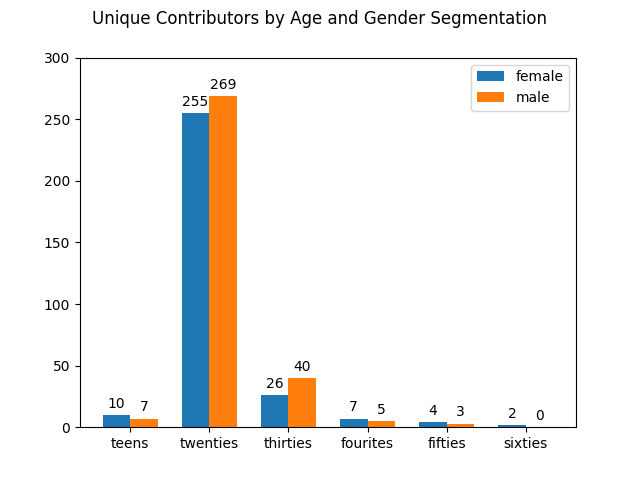
One of the metrics that Mozilla common voice collects is age where contributors have the right to choose which age range they fall upon, studying the Kiswahili voice data set we find close relations between certain age groups and genders with their patterns of contribution to the platform, for example majority of the contributes are in their 20s and in this ages we have a close proximity between women and men contributors and even those who chose not to identify their gender. The bars are almost equally in terms of contributors in their 20’s whether they identify as male, female or other which is not the case from age groups 30’s, forties and this gets even lower almost non existent by the time you reach female contributors between age 50’s and 60’s.
There are proven researches that agree there's a close proximity between age and AI biases,where algorithms are trained off datasets from younger ages hence being trained to be biased against older people.Some have termed this as Digital ageism which refers to ageism reflected design, development, and implementation of AI systems and technologies and its resultant data. Currently, the prevalence of digital ageism and the sources of AI bias are unknown. For common voice we realized there is a close relationship between digital ageism and gender biases in voice technology since most voice datasets are built out of datasets from men aged thirty and below. More women between forties and fifties have less interaction with technology and are less likely to interact with already biased voice assistants that are trained out of men voice datasets.
A report by UNECE states that older persons, particularly older women, are at risk of being left behind in the region’s digital transformation.This is visible also in the embracing of digital skills where majority of older women are less likely to attain access to digital skills, more especially how they can adopt to emerging technologies such as voice assistants.In this Process their a few learnings we gained from our work with building diverse voice datasets on gender and age,which include:
- Start from the basics: To engage older women in contributing to voice datasets or even embracing AI its goes without saying that you need “build them up” offer the skills they need to get started.This might involve offering teachings that are relevant such as basic digital literacy skills,this can involve introducing them to email creation or even how to use the internet.This will not only motivate their engagement but also built up their exploration into different ways they can use and benefit from technology usage.
- Incentivise : For most incentives looks like cash and gifts but what we learned is the importance of skills sharing as an incentive. For example in some communities we realized older women wanted to horn or learn new skills such as speaking new languages such as english, family planning or even how to identify digital fraud.One of our grantees in the DRC coupled data collection and user testing of their land rights application with sexual and reproductive health education to older women.This incentivised engagement of many women including some who couldn't read and write but were willing to donate their voices.
- Partnership with women organizations: One of the ways in which we managed to engage older women was through women only events that we collaborated to plan with organizations that work on women issues.In March 8th on women's day in 2022 one of our community champions partnered with a woman's local organization and brought together over 6o women for voice contributions with over 50% of these participants being in their fifties and sixties.
- Social cultural contexts: one of the huge learnings in engaging older women was understanding that most of them have grown up in patriarchal societies and hence their cultural tries are very relevant to their participation and involvement in voice technology.In some instances we had to go to this woman to break down barriers such as transport to locations where we normally do our activities but we also had to learn their culture.For instance for women in some communities we had to get consent from their husbands or the head of the household in their homes who were mostly men.Despite that we aim to break down gender stereotypes we had to fit into their context for older women to participate in mozilla common voice.
There is undeniably a close relationship between age and gender when it comes to technology uptake whereby the majority of older women are left out in technology.In the case of voice technology when we build with less data from older women we risk building voice assistants that are not responsive to women’s voices.Technology is biased towards certain demographic groups and this includes older women,to build inclusively we need to include women of different age groups along the path.
6 Ways to conduct Gender assessment of voice technology
There is a proliferation of voice assistants often being designed to replicate female gendered characteristics. However, there is much to be desired in voice tech for gender inclusivity for actual participation and meaningful engagement of women. Recent work has found how gendered biases against women are embedded into these systems.This includes Voice assistants bearing women names and Depicting women voices.In the light of this one of the key questions that kept coming up even after the drafting of the gender action plan was how were we going to assess if gender was really being uplifted in the products that the use case grantees were going to build up. Building from the gender action plan we did wide consultations with different stakeholders ,resources and tools available in the AI space to figure out how best we can guide our awardees through this process.We ended up creating a guide that helps voice technology developers to assess and better plan on how to mitigate gender biases and it draws its findings and assessment checkpoints from various gender resources to streamline them towards voice technology.Lets dive into some ways we can assess for gender in voice tech or generally any AI product.
Identify and frame the problem you are solving: This is applicable to different stakeholders from product developers,funding institutions and even organizations supporting responsible AI.Let's unpack what it means to define and frame problems,in our case we had two main domains that our use cases where drawn from this is agriculture and finance. For each use case that was accepted we explored with our awardees asking questions such as who are you aiming to serve and in the process of serving them who else might be impacted,how will they be impacted.This questions helps to draw attention to key considerations such as how will you better be able to propose value or tackle the problem with a solution with minimal or no harm.This is important because when it comes to gender often not thinking about impact (positive and negative) is the point where it's easy for marginalized communities such as women to be further marginalized.
Data quality control : this is a critical area to address because in this instance you have to consider if the data your building from is biased in terms of gender for the case of the kiswahili use case grantees the dataset from common voice already showed the gender metrics of the dataset.In knowing the gender metrics of the dataset its then easy to tell which gender has less or more data and what would that entail when you build or if you will need additional validation or test datasets to evaluate the biases that your dataset might be carrying.We encourage carrying out tests for error rates for different subgroups to determine is there is a higher false positive rate for a certain gender over the other,this means comparing the character error rate (CER)/word error rate (WER) obtained from the testing set versus the evaluation sets created.This will help in identifying the accuracy of your model for different genders or other subsets.Lastly data quality control helps you to identify if your datasets correctly captures all the demographics of populations likely to be impacted by your product.
Fundamental rights and legal requirements:It's critical from the onset of designing one's voice/AI solution to consider fundamental rights and ask questions such as are all fundamental rights protected and adhered to? This includes looking at laws in one's jurisdiction including data protection policies,AI regulations etc.One would need to draft privacy policies ,put in place mechanisms to allow for consent of users of the product and most importantly consider if their product does not infringe on the fundamental rights such as privacy,we put an emphasis on privacy because one of the major challenges of uptake of technology by different genders is trust whereby if no proper mechanism are in place to assure different genders that they can trust the product then there won't be incentive to use it.does your product support the right to privacy and to full control over personal data and information?

User centered design: the center piece to all this is to center the voices of those you intend to serve in this case consider the women group of farmers you aim to serve and engage them in design thinking.This will not only help to identify what they need or what features would solve their challenges but would help you think through the kind of user interface you need to engage your users particularly considering the different personas of the people you intend to serve.Develop personas of a specific gender and engage them in the process to see how to design an interface that would be easier for them to navigate i.e. Auditing user interface for gender in-balances.
Putting in place safeguards:one of the worries of different genders in using technologies is their safety and this boils down to the fact that with newer technologies the risk of cyberattacks has also grown.Intelligent systems such as voice assistants collect a lot of personal and private data from users hence its critical to assess if your product is safe from cyberattacks,hackers and even trolls. Testing the vulnerability of your product is not the only place to stop. One has to go further and put mechanisms in place to ensure such doesn't happen and if they do how will you address the harms they pose.
Monitoring and evaluation plan: Like any good project that is a good product for gender one has to constantly have a monitoring plan to flag down arising signals of bias,attacks and anything that might hinder equal participation of gender.It's imperative to have a plan to evaluate and improve on existing protections in place and user feedback to build better and inclusive to ensure offline harms are not replicated by your products.
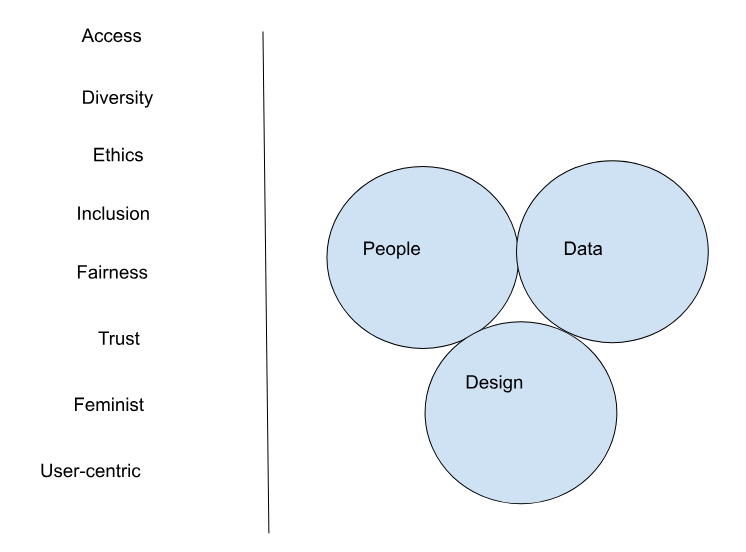
Assessing gender biases in technology is not a one size fits all depending on the context of the communities you aim to serve its critical to consider who holds power in this communities,how can you engage the power holders in the process and most importantly shifting narratives to allow for gender practices that uplift and not stifle one gender over the other. There is a lot of insights to be drawn from different reports and assessments, our learnings deeply drew some ideas and thoughts from the design justice principles,the feminist principles of the internet and the EqualAI Checklist to Identify Bias in AI.
Lifting up partnerships from a gender perspective
A strong pillar in building successful projects is “partnerships” not only does it bring different perspectives to the table but it also shapes agendas from a diverse perspective.In this article we explore how we leveraged partnerships from a gender perspective to uplift gender from community building,dataset curation ,model building all the way to dataset uptake and usage.
1 - Use Case building
In the process of designing the use cases to be supported by the common voice dataset we conducted a survey study to gain community insights on use cases where voice technology can be applied in agriculture and finance in East Africa. In this end we employed a few methods to capture gender in this design stage by doing the following:
- Wide consultation with feminist and gender based CSO’s working on agriculture and finance from a gender perspective: we carried out interviews with different societies and groups including chama’s, women farmers associations and groups and the main aim in this was getting insight on how and which use cases will address specific gender concerns.This consultation led to identification of specific gender use cases such as women land rights and support for chama’s.
- Development of gender specific use cases addressing needs identified by gender stakeholders in the field of agriculture and finance. These use prototypes were also subsequently tested by the respective gender groups to check if they captured the concerns and addressed impact to specific groups.
2 - Data collection
Majority of our work was geared towards building a diverse and inclusive dataset hence the efforts were deliberate from the start to ensure that is captured,this was not only an emphasis in the gender action plan but overall in the whole programing of the project. Below we capture ways in which we leveraged partnerships to lift up gender in the data collection stage:
- Engagement of gender groups,in sentence curation as well as voice collection; we partnered with entities such as universities and gender focused NGOs to build text corpus and in this case we specifically hosted activities that would uplift gender participation by working with partners who were already working on gender.
- Supported women led and women focused organizations/events to host voice drives:One of the things that came out of this was the realization of gender device gaps hence the partnerships with groups that focused specifically in gender helped to ensure availability of access and devices through partners spaces hubs for gender groups who have no access to contribute.Example of such partnerships included with Pwanitecknogirls in mombasa,the Arusha women school on internet governance in Tanzania and Core23lab in the DRC.
3 - Community building
One of the key success factors for the common voice work was that community was at the heart of the project from its inception. In this case we had to think of how we could be able to build on gender from the community level,in this instance both the language and tech community.This is how we leveraged partnerships to build on gender:
- Community champions: we realized that we wanted to capture diverse and inclusive voice and it was going to be impossible for us to be everywhere hence we worked with communities and stakeholders such as NGOs and hubs to identify community champions who are able to reach communities we couldn't reach.In this effort we were deliberate in picking majority women community champions to helps us spearhead data collection of underrepresented genders.Some of our champions went as far as collecting voices of older rural women to queer communities.
- Partnerships with gender groups;this goes without saying the most success we had at hosting gender focused drives were those in which we partnered with partners that work specifically on things such as women empowerment programs.
4 - Dataset uptake and usage
One of the crucial stages where gender biases can be addressed is the model building stage where after much reflection we utilized partnerships as well to promote uptake of the common voice dataset and its usage from a gender perspective by this i mean how we can build gender responsive models from the dataset.Some ways we did that included:
- Organized hackathons with an emphasis on models that perform well on different genders in partnership with Zindi,Africa’s talking and Swahilipothub; this hackathons had a strong emphasis on inclusion of women including comparing the overall performance of the model with how it compares on the following evaluation sets representing the following demographics such as Women,Women under 30 And Women over 30 among others.These hackathons were conducted across Tanzania and Kenya with support from different partners including community champions.
- Presentation of the common voice work and dataset at partners conferences: we utilized platforms given by partners such as the africa AI conference to present how one can make use of the data and the diversity of our data.This was a great way to share how our data has training sets on different genders and other demographics critical at evaluating biases.
Partnerships level the playing field especially when it comes to gender. In our case partnerships played a crucial role at helping to uplift gender by bringing to the table diverse thoughts,ideologies and perspectives.Different actors can take up tangible actions to deliver on gender equity and equality at different stages of the AI ecosystem. A report by McKinsey and company States that “ Gender inequality is complex by nature; it cuts across all sectors, interlinks with other areas of development, and requires solutions from many actors including those in government, corporations, and nongovernmental organizations (NGOs).”Hence the need to think through how to establish and uplift partnerships to tackle gender disparities when it comes to emerging technologies such as voice tech.
Gendered realities: learnings from MCV awardees on Gender
In 2022 mozilla common voice awarded a total of 400,000$ in grants to 8 awardees across three countries of Kenya,Tanzania and the Democratic republic of Congo to build solutions out of the kiswahili common voice datasets.It was deliberate from the beginning to seek projects that are gender inclusive in nature by ensuring the teams of the projects selected comprised of women and had a gender focus in the product they are building.This awardees worked on several projects ranging from the maize value chain,orange flesh potatoes ,climate change,corporate serving groups all the way to land rights.This awardees were supported at different stages on how to build with gender in mind,here are some gendered realities that they experienced and learnt along the way.
Gender device gap:One of the challenges that the awardees faced both during data collection as well as introducing the applications to the communities was the gender device gaps where majority of women did not own smartphones let alone feature phones.One of the grantees who was working on land rights for women in DRC says they had thought of this gap long before project implementation and hence had budgeted to hand over a few phones to women community leaders to help spearhead the movement.However they still felt that even with providing access through leaders of the women groups there was still a fear that the mean might take it over so they enlisted the help of a woman chief in the community who is ensuring that the phone stay in the hands of the women and for the purpose of sharing knowledge with others.
Communities are patriarchal:All the awardees agree that the culture in the communities they worked embarrassed patriarchy and hence their practices did not give women the right to engage in big decisions including ownership of mobile devices.One of the awardees SEE Africa who build an orange sweet potato flesh app called Kiazi Bora states that “These cultural practices and beliefs have always placed men above women, this has led to women being excluded from education and income generating opportunities; and as a result majority of women are limited to only doing household chores, majority cannot use smart mobile phones because of lack of education and exposure.”This was the case across the awardees where the communities they worked in did not value the women although they were in most cases the main producers in farms.
Access gaps:Being able to meet and engage rural women was a big challenges especially because their was not only devices gaps but in rural areas there was also connectivity challenges where by majority had low end devices and in some cases internet was low or unavailable.It was reported by DuniaCom one of the awardees that build a solution for the maize value chain that Poor internet connectivity in rural areas prohibits consistent use of mobile applications and adoption of voice-based agricultural value-added services. “While this has significant implications for gender and inclusion, it also represents a potential market loss for voice-based AgriVas solutions.”
Women had lower literacy levels : It was noted by most of awardees that the communities they engaged with there was a huge disparity between men and women when it comes to literacy ,more men had education compared to women.Think who developed the chama application says”Most Member that we interviewed with highest level of study as Primary School had a timid look on financial matters and were not as bubbly as more learned persons, The timid persona had little to no control to financial matter Cultural background also plays a role in this. “This was also observed by Core23lab who noticed that most of the women they were trying to engage did not know how to read nor write hence limiting their engagement with digital devices and tools even further.
Trust and data protection challenges: While laws exist in countries to protect against data breaches there are no gendered laws that address the digital threats women face in digital platforms.DuniaCom states that “For instance, the project came across a significant number of households in which sim-cards used by women were registered under men. This contravenes the existing cybercrimes ACT in 2015. The development of voice recognition technology in particular needs to be supported by appropriate policy and regulatory frameworks that are understood and adopted by businesses and innovators. Otherwise, it would lead to gaps in transparency, accountability, safety, and ethical standards of the technology that are likely to be detrimental to gender and digital inclusion, and damage the promises of voice recognition technology in development.
Power dynamics: Women have limited decision-making power at the household level. For example Badili, one of the awardees, states that “we were informed at the workshop that Masai women don’t make any decision regarding selling cattle, goats or sheep. They can only decide on poultry.”Strathmore says” Women have lower decision-making power concerning some farming activities, therefore, climate adaptation practices that are suggested may not be implemented. The design of climate adaptation practices can take a gendered approach to ensure uptake.”
Women are more vulnerable to digital/online risks than men (e.g., women experience more harassment from strangers, receive unsolicited messages, and face intrusion of privacy). The fact that women are more digitally illiterate than men, makes them more vulnerable to digital/online risks. These risks are also underpinned by gender norms as men are expected to play the role of gatekeepers and always control how women access and use digital technologies due to fears that the technologies are not only unsafe, but also have corrupting influences on women. Some risks are internalized by women themselves as many believe it is acceptable for their devices and communications to be monitored by men who are perceived to be more literate and less prone to digital harm.
The gendered realities of technology adaptation prove that there is a lot of work to be done to achieve parity and even adaptation of solutions such as voice AI,it needs a closer look at gender,gaps and finding solutions that allow the community to thrive inclusively beyond glamorous AI solutions.It's advised that involving women in the process gives the project acceptance and legitimacy for other women this includes having women AI experts or even women community champions spearheading the adaptation of the applications.Dismantling patriarchy in a did to do away with digital exclusion requires breaking it down in manner that informs the community that empowering women is not a threat.
While these challenges persist the common voice awardees believe there are ways to mitigate them,their learnings on digital exclusion especially where gender is concerned have those two tied together.See Africa believes that “Digital exclusion cannot be arrived at without addressing gender exclusion, gender exclusion precedes digital exclusion; digital inclusion requires a firm background in understanding the values of gender equality which provide room for people of all genders to access education and thus get exposed to other aspects of the developing world including digital technology.”
A feminist approach to text corpus creation
Language models are becoming increasingly central to artificial intelligence through their use in online search, recommendation engines and language genera- tion technologies. It has been urged that concepts of gender can be deeply embedded in textual datasets that are used to train language models, which can have a profound influence on societal conceptions of gender. The representation of gender in large text corpus matters not only from the creation perspective but also from the aspect of how the resulting models perceive gender.Common voice as a platform has provided avenues for text corpus to be created and contributed to by communities through the sentence collector,however there are deliberate efforts on how this texts can be gender inclusive.At the beginning of the work of building the kiswahili text corpus we employed different methodologies and learnt a lot from them,one of the things we realized is that there is a gap in terms of text corpus that uplifts different genders.This coupled with the realization that there is not enough women building AI solutions like language models nor are their stories told especially in the communities we were working with.This learning allowed us to integrate the need to create feminist content and use it to amplify women voices while also creating a feminist text corpus.Our approach included:
Feminist write-a-thons:It was important to curate content that is relatable to the community hence why this contents were to be developed by the communities themselves.This included conducting feminist write-a-thorns were participants delved into creating content around gender,AI and the people around them.The first session was through MozFEST virtual where the participants who joined the session were introduced to the history of the swahili queens along the east african coast and their role in the growth of the language.Then they engaged in using swahili proverbs to create powerful feminist narratives.This narratives were later cleaned by splitting them into eligible sentences and uploading them on the common voice platform as part of the kiswahili text corpus.The benefit of such narratives was it did not only demystify the concept around the role of gender in development of languages but it also addressed areas of importance such as power dynamics in communities.
Writing competition of feminist stories:In 2023 a writing competition was launched on women's day with the aim of curating stories of women change makers in the three countries the Kiswahili work was focused on.In this instance a set of guiding principles for participation were put forward including the need for them to focus on women within their communities,writing in their swahili with hopes of bringing to light invisible women in various spaces while also building a feminist text corpus.The writing competition was dubbed “ wanawake mashujaa “ covering stories from Kenya,Tanzania and the Democratic Republic of Congo.The competition was open to people of all genders to submit written content in their preferred swahili dialect under CC0.The “Wanawake Mashujaa” Competition — Kiswahili for “Brave Women” — called for written biographies of extraordinary women in local communities across Tanzania, Kenya, and the DRC. There were specifications on how this was to be written in a manner that respected gender diversity but also allowed for the text to go into the common voice Kiswahili corpus.A collection of over 40 stories of 40 powerful women were submitted and out of this 9 winning essays were awarded for being exceptionally written by a panel of linguist and literacy judges of the Kiswahili language.This approach enabled us to not only create a text corpus but ensure it shines a light on impact of women in society.
Validation of Text Corpus:Common Voice gives power to contributors to decide what they consider an accurate representation of their language.In this instance any text that goes on the platform has to be from verified sources that have approved text to be CC0 but also adheres to the platform principles of inclusivity.The sentence collector accepts sentences but they go through a community drive validation which allows for any text that discriminates against demographics or is delegatory in nature to automatically be dismissed and not approved for public viewing.
While this was a way to generate more text from a gendered lens it was also a learning experience about the role of text in fostering gendered biases in a dataset and eventually a language model.Here are excerpts of learning about the dynamics of languages and gender from a feminist perspective:
Gender of words(lexicon): Most often words are already gendered when they are written depending on the languages now in the case of swahili languages nouns are what differentiate males from females while the pronouns remain gender neutral.This is not the case for example in English where a chair leader is often referred to as chairman and not chairlady which as people become more gender aware has now changed to chairperson in efforts of being gender neutral.Understanding how text created carry gendered meanings behind them help shape how we approach creating feminist content that can be utilized in language models.Marion and levy(2023) in their paper argue that finding gender-neutral replacements for gendered words, such as police officer instead of policeman can help to assess gender-inclusive language strategies in a text and thus whether its authors support a binary conceptualization of gender.
Creation of gender inclusive text:while different languages have different ways of expressing gender one method that can help address this is to strip gender identities to text specifically depending on your intended use.Targeting male-as-norm language replace it with more inclusive forms and, after training AI models on these more gender-inclusive texts, measure the impact of gender-based data curation on gender bias. Fostering the use of more inclusive language and no sexist language, the effect could also be absorbed by AI systems trained on gender-inclusive text. In the case of the writing competitions by Common voice this method was used where participants of the competition were urged to use inclusive language and due to the fact that swahili’s pronouns are neutral hence the text allowed for text data that is neutral.
Data has a key role to play in eliminating gender biases in this particular case addressing the challenge from the root included looking at what text is being fed into the systems and how we can better biases at that level.The guiding principles of what kind of text is accepted on the platform also emphasis on this by being keen to ensure text is validated before its officially published on the platform.It is essential to take an approach of curating text data that does not replicate existing gender biases in the communities but rather demystify the concept of gender from a feminist approach of gender and social justice.